RSNA 2025: Healthcare is in the Crosshairs but is Rising to the Challenge

By Peter Eason, CFO/COO Ferrum Health.
Hospitals, especially in rural locales, are struggling to stay afloat amid rising operating costs. The financial impact of expected changes to Medicaid and Medicare looms large and unpredictable, and rising insurance premiums threaten to make basic coverage unaffordable for many Americans, adding pressure on already strained systems.
Yet, as healthcare leaders do in moments of need, they don’t complain, they find solutions. Across the country, organizations are looking inward, innovating, and rethinking how to sustain care delivery for the patients who rely on them most. Recent data shows that healthcare is now outpacing other industries in integrating AI into daily practice — a credit to leaders making bold, forward-looking changes in the face of uncertainty.
At RSNA 2025, Ferrum Health is proud to stand alongside those leading this next chapter — helping health systems make AI not just deployable, but dependable. Below are the key topics we expect to shape this year’s event and their significance for health systems ready to adopt.
1. Enterprise Adoption Requires Strong Governance
A primary theme will be the shift to enterprise-wide AI adoption, which relies on strong AI Governance. One challenge for health organizations is what does “Governance” mean? The word appears in nearly every AI discussion, yet is still amorphous and inconsistently defined. Nearly a dozen organizations have proposed their own frameworks, but few provide a clear path from theory to implementation.
- At its core, Governance shouldn’t be about more paperwork or policies — it’s about thoughtful, efficient processes that help health systems assess, onboard, and monitor AI responsibly. The real differentiator will be those who can deliver clinician-, IT-, and admin-forward measures of performance — making oversight continuous, not one-time.
- Healthcare doesn’t need another abstract framework. It needs a solution — one that makes AI oversight secure, predictable, and measurable. That’s exactly where Ferrum Health is focused: turning governance from a buzzword into a scalable, operational reality.
“The industry has realized AI adoption isn’t just an IT issue or a clinician trust challenge, it’s a health-system wide governance problem, it’s a clear need for a standardized framework to evaluate, deploy and monitor behavior. The mission-critical work now is to build the centralized digital nervous system that validates, secures, and controls an entire portfolio of AI, ensuring every algorithm delivers equitable, reliable performance for every patient, every day. That trust layer is the new competitive differentiator for health systems.” says Austin Deer, Head of Strategic Partnerships, Ferrum Health.
2. Foundational Models Take the Stage
Major technology announcements will focus on Foundational Models (FMs), which are large, general-purpose AI models trained on diverse datasets and capable of handling multiple tasks on a given exam.
- Foundation Models (FMs) promise to reshape how AI is developed and deployed in healthcare — but not by eliminating the need to train. Instead, they speed up the time to train by reducing the variety and volume of studies required to reach strong baseline performance.
- As healthcare knows well, performance around the tails is what truly matters — the infrequent, complex, or ambiguous cases where algorithms differentiate themselves. FMs serve as a powerful general starting point, and when ensembled with existing FDA-cleared models, they often deliver a few percentage points of improvement. Yet on their own, they’re not yet performant enough to handle the full breadth and complexity of what clinicians encounter daily.
- As the promise of FMs grows, the real opportunity lies in isolating the right datasets for local retraining. That begins with having the tools to measure AI performance, identify where results fall out of band, and focus retraining on those specific populations. Governance and observability will be central to making this next wave of model development truly impactful in clinical practice.
3. Consolidation of the Vendor Space
Don’t be surprised if a few familiar names are missing from the RSNA 2025 floor — not because they forgot to book a booth, but because the long-anticipated wave of consolidation in clinical AI is finally materializing.
- The Clinical AI vendor landscape is becoming a story of haves and have-nots. Models that are differentiated, clinically validated, and show multiple paths for growth are finding strong reception from customers and investors alike. Those that aren’t are looking for a new home — or an exit.
- As this shake-out accelerates, health systems are prioritizing flexibility. They need partners who can quickly swap out algorithms as vendors merge, disappear, or new innovators emerge. The future belongs to platforms built for agility — those that make it easy to integrate, retire, and replace models without disrupting clinical operations.
4. The Age of AI Observability
Reporting AI performance based solely on output ratios (eg. how many predictions are normal versus abnormal) is no longer good enough. One-time, upfront analyses at launch might check a box, but they underdeliver in practice. Think about it: does Amazon lose track of its planes once they leave the hangar? Of course not. Continuous visibility is the only way to ensure reliability at scale..
- Observability involves real-time monitoring of algorithm performance after deployment. It enables early detection of performance degradation or unfair outcomes in specific demographics.
- Ferrum Health’s Automated Validation and Performance Management make AI Observability actionable. This approach supports clinical confidence and regulatory compliance without requiring manual review of each algorithm.
“The pace of AI innovation is relentless. What health systems need now are smart, automated ways to measure AI performance continuously. It’s a dire need for identifying drift, bias, or out-of-band behavior early, without requiring constant human annotation. That’s the real promise of observability: keeping AI accountable and reliable, in real time, across the enterprise.” explains David Hilderbrand, CCO, Ferrum Health.
5. Seamless AI: Truly Functional Integration
Like any good product, adoption is ultimately driven by its real-world utility and ease of use. The good news: PACS providers have made real progress. Gone are the days of vaporware and idealized demo environments; leading PACS providers are now delivering true integration that enables AI insights to appear seamlessly within the tools clinicians already use daily.
- Direct Interaction: Features like a simple "Accept/Reject" button for AI findings directly in the viewer will be touted as available product offering.
- AI results will be delivered as integrated toolkits within the reading environment, supported by secure internal AI caches to provide immediate access without delays.
- Pixel to paragraph. Whether you are using a third party dictation tool, or a PACS-integrated option, all reporting tools are now beginning to support pre-drafted reports. This begins to unlock a new step-function of productivity for users who TRUST the Clinical AI tool, while also understanding its areas of weakness. Most users report its best to understand the pixel performance, before unlocking this.
- The goal is to eliminate context switching, reduce the time and cognitive effort required of radiologists, and ensure AI enhances rather than disrupts the diagnostic workflow.
The momentum around RSNA 2025 reflects a shift to strategic, governed enterprise AI deployment. Foundational Models, vendor consolidation, and AI Observability are converging to make AI a safe, efficient, and integrated part of radiology. To avoid falling behind, visit us at RSNA 2025 to learn more about AI Governance, or schedule a meeting to discuss your strategy:
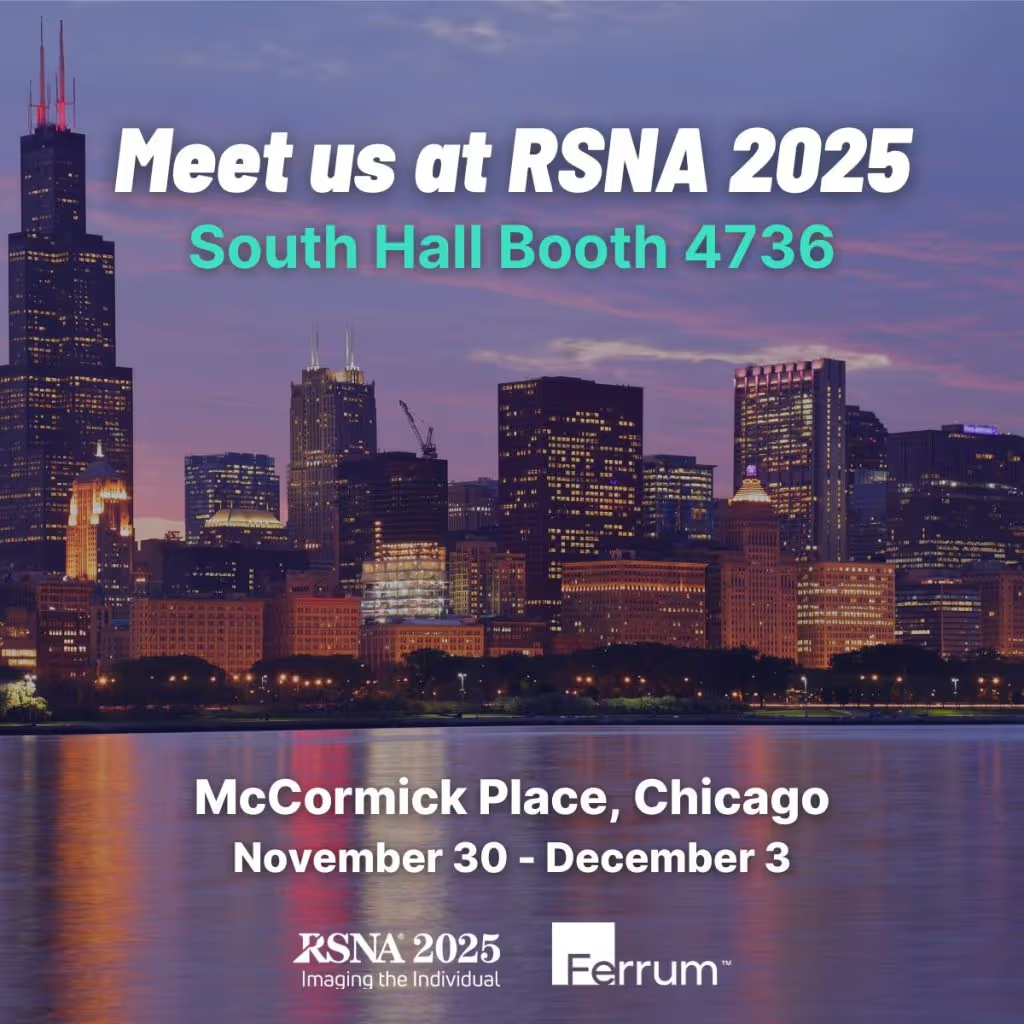
To position your health system as a leader in AI adoption, consider the following steps:
1. Book a strategy session with our team.
2. Prepare any specific questions or challenges your system is facing regarding AI integration.
3. Identify key stakeholders who will benefit from attending RSNA 2025 and extend the invitation to them.

.jpg)